The Guard Editor
Selecting Edit on a guard row, or opening a guard from the guard list, opens the guard editor: a dedicated page for one guard. The header shows the guard's name, its status (Active or Draft), its category (Runtime or Build-time), a Playground button, and a Publish / Unpublish control.
The editor has four tabs: Overview, Checks, Filters, and Settings.
Overview
The Overview tab summarizes the guard: its checks, filters, and recent activity.
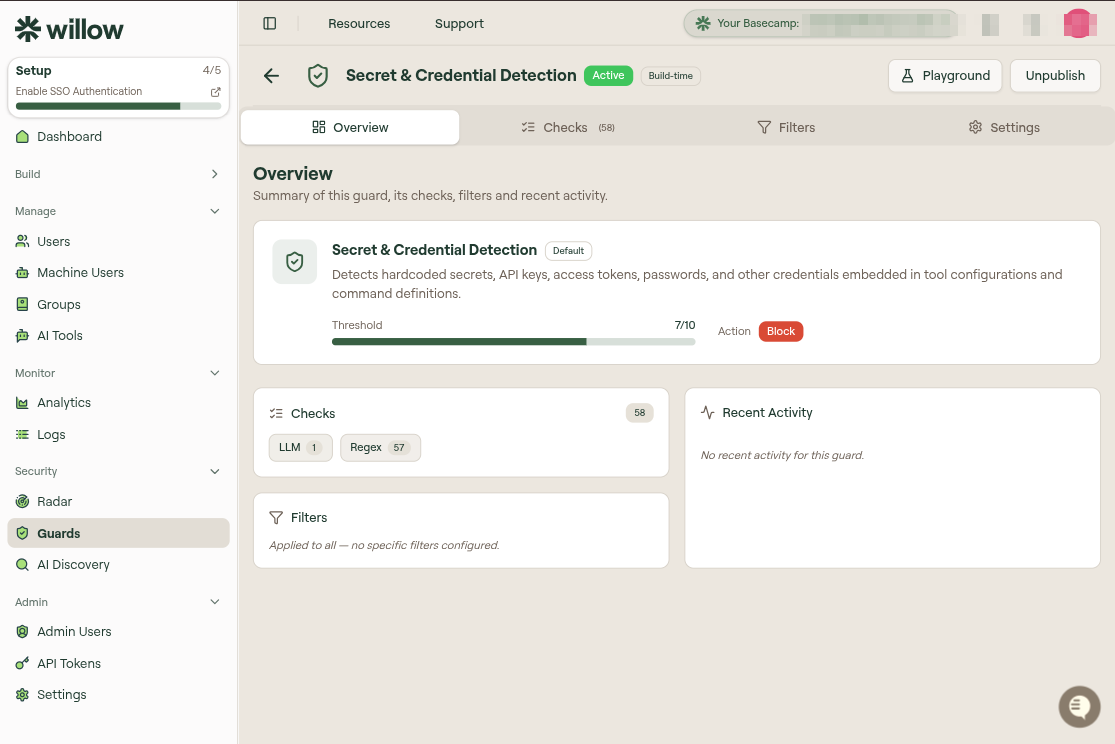
- The summary card repeats the guard's name, description, Threshold, and Action.
- Checks shows the total count and a breakdown by type (for example,
LLM 1,Regex 57). - Filters shows the current scope, or
Applied to all — no specific filters configuredwhen the guard is unscoped. - Recent Activity lists recent times the guard fired, or
No recent activity for this guardif it has not triggered.
Use Overview as a read-only snapshot; make changes on the other three tabs.
Checks
The Checks tab lists the checks that make up the guard and lets you add, edit, and enable them. The header shows how many are active (for example, Checks (58 of 58 enabled)).
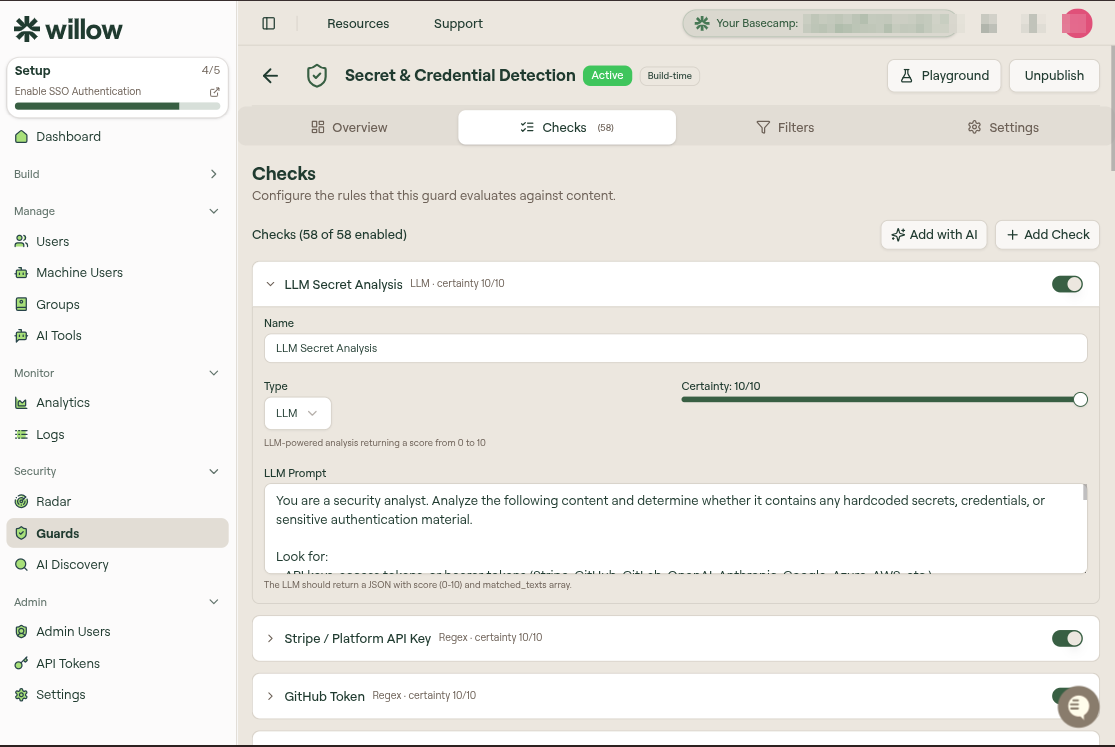
Each check appears as a row showing its name, its type and certainty (for example, Regex · certainty 10/10), and an enable toggle. Expanding a check reveals its Name, Type, Certainty slider, and the type-specific configuration (such as an LLM Prompt). Add checks with + Add Check or Add with AI, then select Save Changes. Add with AI appears only when Bring Your Own AI is configured.
For the full reference on each check type and how certainty combines into the guard score, see Guard check types.
Filters
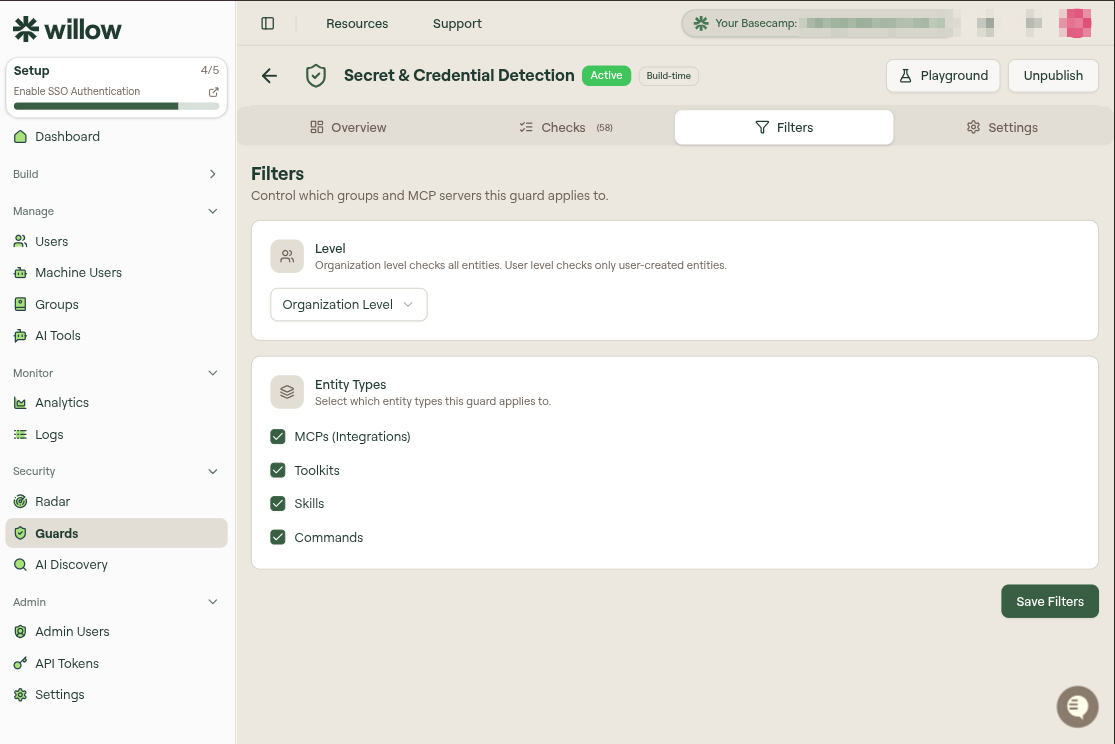
The Filters tab controls which groups and entities the guard applies to.
| Control | Options | Effect |
|---|---|---|
| Level | Organization Level or User Level | Organization level checks all entities in the organization. User level checks only user-created entities. |
| Entity Types | MCPs (Integrations), Toolkits, Skills, Commands | The guard evaluates only the entity types you check. |
Select Save Filters to apply. With no filters set, the guard applies to everything, which the Overview tab reports as Applied to all.
Filter by User Risk Score
When the User Risk Score beta flag is on, the Filters tab gains a switch that narrows the guard to users inside a risk band. Set a Minimum score, a Maximum score, or both; both bounds are inclusive and either can be left empty for an open-ended range. Also apply to users with no risk score is off by default, so tightening a guard onto risky users does not quietly catch everyone who has not been scored yet.
This is the softer alternative to blocking: a guard set to 70–100 gives your riskiest users extra scrutiny while everyone else works unimpeded. The band applies to runtime guards only — build-time guards run without a user in context and ignore it. See User Risk Score.
Settings
The Settings tab holds guard-level configuration in four collapsible sections. Each section has its own Save Changes button, so save the section you edited.
General
The guard's identity: Name, Slug, and Description. The description is what admins see in the guard list, so state plainly what the guard detects.
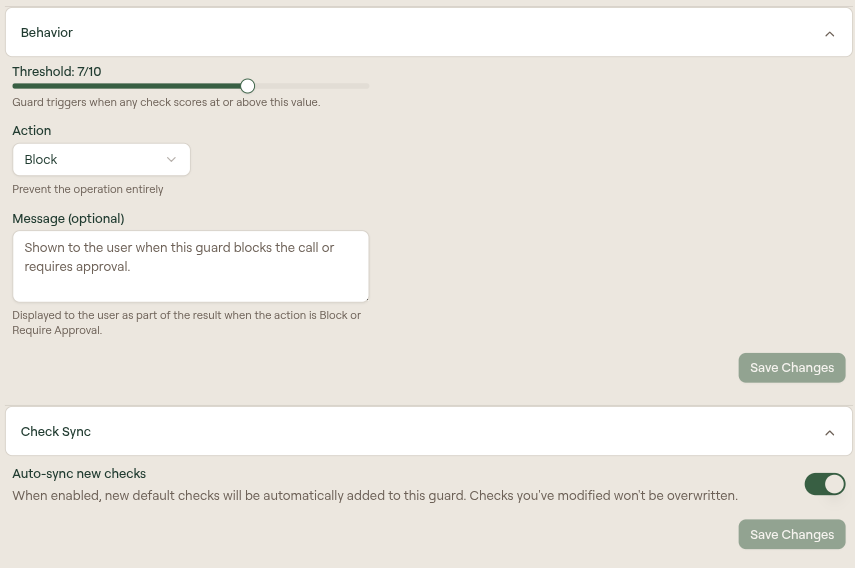
Behavior
How the guard fires and what it does:
- Threshold slider. The guard triggers when any check scores at or above this value.
- Action: Redact, Warning, Require Approval, or Block. A short line beneath the dropdown describes the selected action (for example, Prevent the operation entirely for Block). See Actions for what each one does.
- Message (optional). Text shown to the user as part of the result when the action is Block or Require Approval. Use it to explain why a call was stopped or what the user should do next. It has no effect for Redact or Warning.
Message placeholders
A message can quote what the guard actually caught, so the user sees the offending value instead of a generic reason. Click a placeholder below the field to insert it at the cursor:
| Placeholder | Replaced with |
|---|---|
{{matchedText}} | The content that triggered the guard. Long matches are shortened, and only the first few are listed (the rest become (+N more)). When the check reports no snippet — an LLM or built-in check often scores content without quoting a fragment — it reads the flagged content instead. |
{{checks}} | Names of the checks inside this guard that triggered. |
{{guardName}} | The guard's name. |
{{score}} | The highest score any of its checks returned. |
{{threshold}} | The guard's threshold. |
For example, Blocked: "{{matchedText}}" looks like a credit card number. reaches the user as Blocked: "4111111111111111" looks like a credit card number. A placeholder that isn't in the table is left in the message as you wrote it, which makes a typo easy to spot.
{{matchedText}} puts a piece of the scanned content into the message the user (and their AI agent) sees. Audit logs are unaffected: they store the message as you wrote it, so an org that redacts content from its logs stays redacted.
Check Sync
Auto-sync new checks keeps a built-in guard current as Willow adds detectors. When enabled, new default checks are automatically added to this guard; checks you have modified are never overwritten. Turn it off if you want the guard's check set to stay exactly as you left it.
Danger Zone
Two irreversible or disruptive actions:
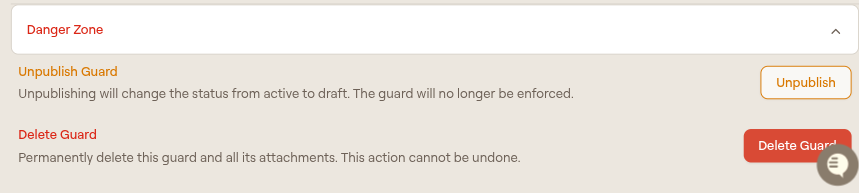
- Unpublish Guard changes the status from active to draft. The guard stops being enforced but is not deleted, so you can republish it later.
- Delete Guard permanently deletes the guard and all its attachments. This cannot be undone.