Guards
Guards are Willow's content security layer. Each guard is a set of checks that inspect content at a specific point in the system and produce a decision: allow it, block it, warn, require approval, or redact the sensitive parts. You manage all of them from Security > Guards.
For the conceptual split between the two categories and where each one fires, see Guards: Runtime vs Build-time.
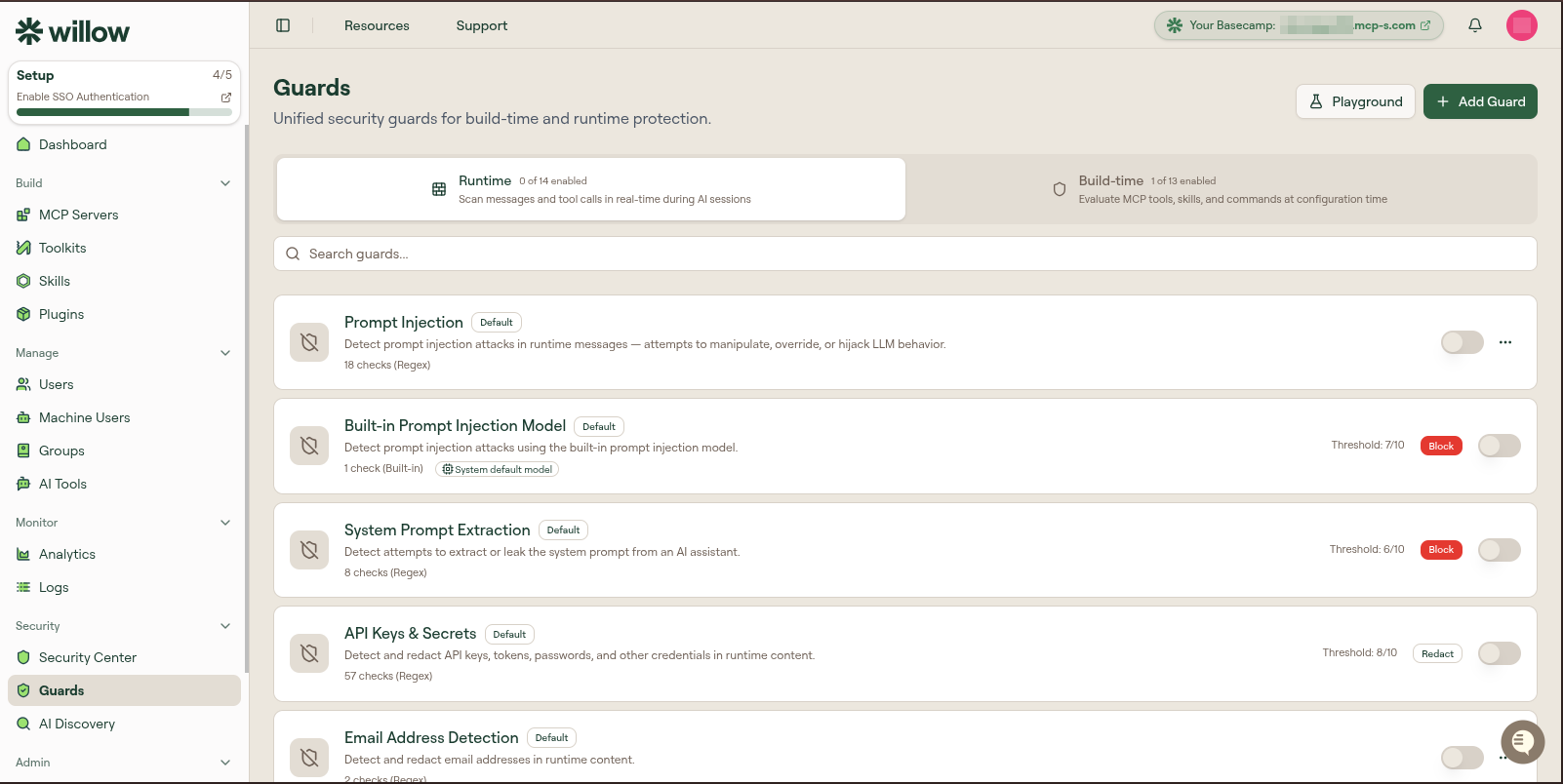
The two tabs
The Guards page has two tabs, each with its own list:
| Tab | Fires | Evaluates |
|---|---|---|
| Runtime | On every MCP request and response through the gateway | Live tool calls and responses: tool name, arguments, and results |
| Build-time | When an admin publishes a toolkit or plugin | The content being distributed: tool selections, embedded prompts, skill text, command definitions |
Runtime guards are the primary enforcement mechanism for live usage. Build-time guards block non-compliant content before it ever reaches a user's AI client. The list supports search and filtering, and each tab shows how many guards are enabled (for example, 0 of 14 enabled).
Page controls
Three controls sit above the tabs:
| Control | What it does |
|---|---|
| Setup & Coverage | Opens Guard Setup & Coverage, which reports which surfaces beyond the gateway are enforcing your guards and starts the setup for the ones that are not. |
| Playground | Opens the Guards Playground to test content against a guard. |
| Add Guard | Creates a new guard. See Create a Guard. |
Anatomy of a guard row
Each guard in the list shows:
| Element | What it shows |
|---|---|
| Name | The guard name, with a Default badge for Willow's built-in guards or a green Published badge once the guard is live |
| Description | What the guard detects, such as "Detect and redact dates of birth in runtime content" |
| Checks | The number of checks in the guard and, for simple guards, their type (for example, 2 checks (Regex)) |
| Threshold | The score, out of 10, at which the guard fires (for example, Threshold: 8/10) |
| Action | What happens when the guard fires (see Actions) |
| Toggle | Enables or disables the guard |
Enabling and publishing
Toggle the switch on a guard row to enable it. A green Published badge appears next to the name and the guard is immediately live. There is no separate publish step. Every tool call through the gateway is evaluated from that moment on.
Thresholds
The threshold sets the guard's sensitivity on a 0-10 scale. A guard fires when the combined score of its checks reaches the threshold. Lower thresholds catch more content and risk more false positives; higher thresholds are stricter. For a regex check, any content matching the pattern typically scores 10/10, so it fires at any threshold at or below 10.
Actions
When a guard fires, it applies the action configured on the row. Open the action dropdown to change it:
| Action | Effect |
|---|---|
| Redact | Allows the call but replaces the matched content with a placeholder |
| Warning | Allows the call and logs a warning for review |
| Require Approval | Holds the call pending an approval decision |
| Block | Stops the call and returns a guardrails error to the AI client |
Require Approval only applies to a tool's input (before it runs). On the first triggering call, Willow creates a pending approval and returns a link to an approval page where a user can see which guards flagged the call and why; once it is approved, retrying the identical tool call proceeds without prompting again. Because an already-executed call can't be paused, a Require Approval guard that fires on a tool's output is automatically downgraded to a Warning.
If more than one guard fires on the same call, Willow applies the most restrictive outcome: Block over Require Approval over Redact over Warning.
Row actions
The overflow menu on a guard row exposes:
- Edit / Edit Checks / Filters open the guard editor on the corresponding tab.
- Unpublish takes a live guard offline without deleting it.
- Duplicate creates a copy you can modify.
- Delete removes the guard.
The guard editor
Selecting Edit opens a dedicated page for the guard. The header shows its status, type, threshold, action, and check count, plus a Playground button and Publish / Unpublish control. It has four tabs:
| Tab | Contents |
|---|---|
| Overview | Guard summary, status, and recent activity |
| Checks | The checks that make up the guard, each with a type and configuration. See Guard check types. |
| Filters | The scope the guard applies to (organization or user level, and entity types such as MCPs, Toolkits, Skills, and Commands) |
| Settings | General details (name, slug, description), Behavior (threshold, action, and an optional user-facing message), Check Sync, and a Danger Zone |
For a full walkthrough of every tab and setting, see The guard editor. To build a guard from scratch, follow Create a guard.
Built-in guards
Willow ships a catalog of built-in guards, disabled by default, that you enable and tune. They run locally and require no external API keys.
Runtime guards
Prompt Injection, Built-in Prompt Injection Model, System Prompt Extraction, API Keys & Secrets, Email Address Detection, Phone Number Detection, SSN Detection, Credit Card Number Detection, IP Address Detection, Financial Data Detection, Date of Birth Detection, Government-Issued ID Detection, Person Name Detection, Toxic Content, and Profanity.
Build-time guards
Secret & Credential Detection, Prompt Injection Detection, Email Address Detection, Phone Number Detection, SSN Detection, Credit Card Number Detection, IP Address Detection, Financial Data Detection, Physical Address Detection, Date of Birth Detection, Government-Issued ID Detection, Data Exfiltration Risk Assessment, and Code Injection & Unsafe Execution.
Each built-in guard carries a sensible default threshold and action. For example, Secret & Credential Detection defaults to a 7/10 threshold with a Block action across 58 checks, while Email Address Detection defaults to 8/10 with Redact.
Connect a provider
Below the runtime guard list, the Connect Providers cards add external content-safety engines: Alice, Prompt Security, and a Custom Webhook. See Guard providers.
Test before you rely on it
Use the Guards Playground to run sample content through a guard and see the exact decision, score, and matched checks before you publish.