The AI Discovery dashboard
Once devices report successfully, the AI Discovery page fills in. Its header carries Setup Instructions, Run Guard Check, and a refresh control, and the content is split across eight tabs. Each capability tab shows a count.
| Tab | What it shows |
|---|---|
| Overview | Governance summary and risk rollup. |
| MCP Servers | Every discovered MCP server, with the AI agents and devices using it, and a risk indicator. |
| Skills | Discovered agent skills and their governance status. |
| Agent Memory | CLAUDE.md and AGENTS.md files found on developer machines. |
| AI Agents | AI tools in use across the organization. Empty until devices report or the browser extension detects web AI usage. |
| Devices | Connected machines with their user, capability counts, agent version, and last scan time. |
| Auth Discovery | OAuth flows captured by the browser extension. |
| Policy Rules | Enforcement rules that allow, warn, or block discovered capabilities. See Policy Rules. |
Overview
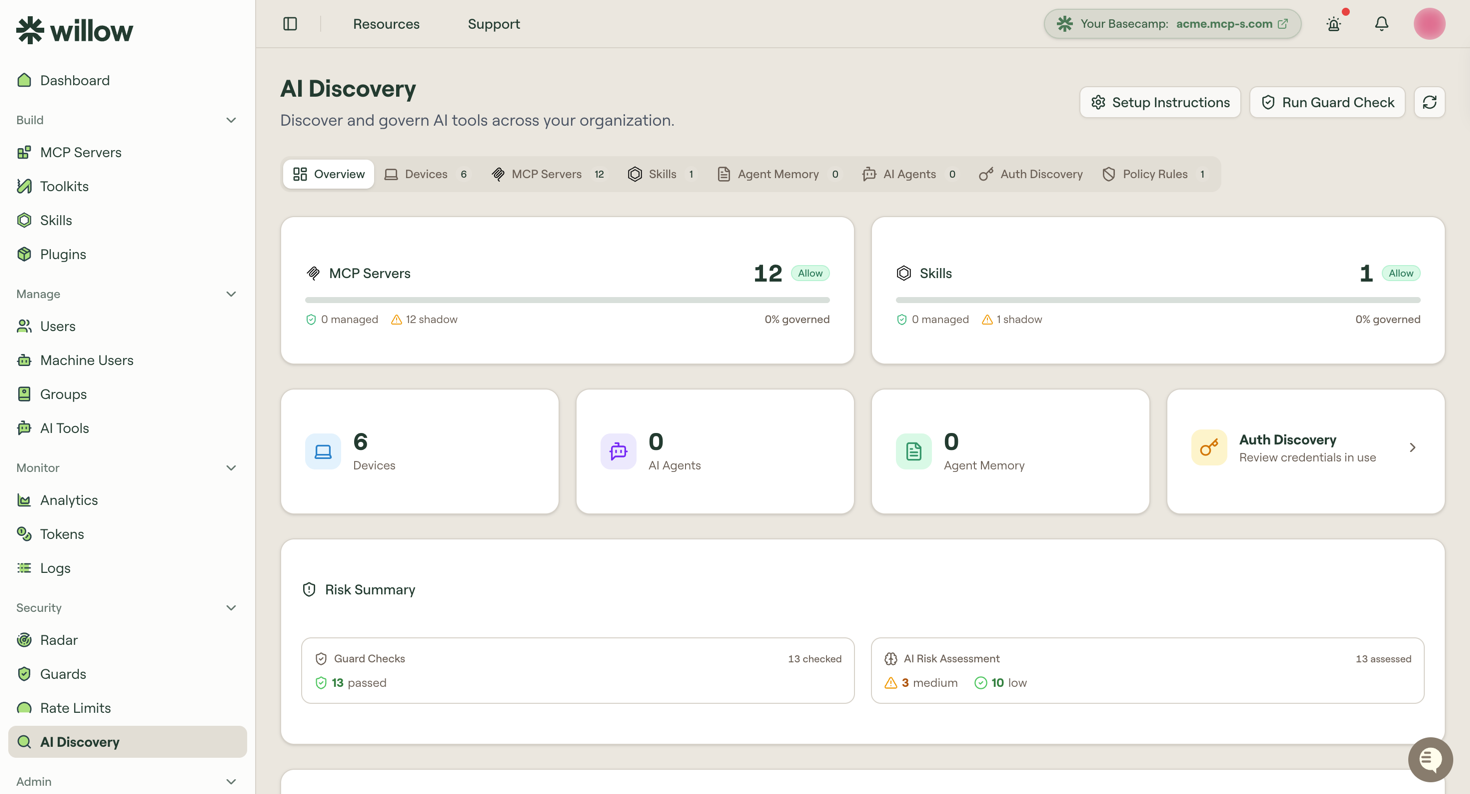
Cards for MCP Servers and Skills each show a total, a policy badge, a managed-versus-shadow split, and a % governed figure. Separate cards count Devices and AI Agents.
A Risk Summary panel below reports Guard Checks (how many capabilities were checked and how many passed) and AI Risk Assessment (how many were assessed, broken down by risk band).
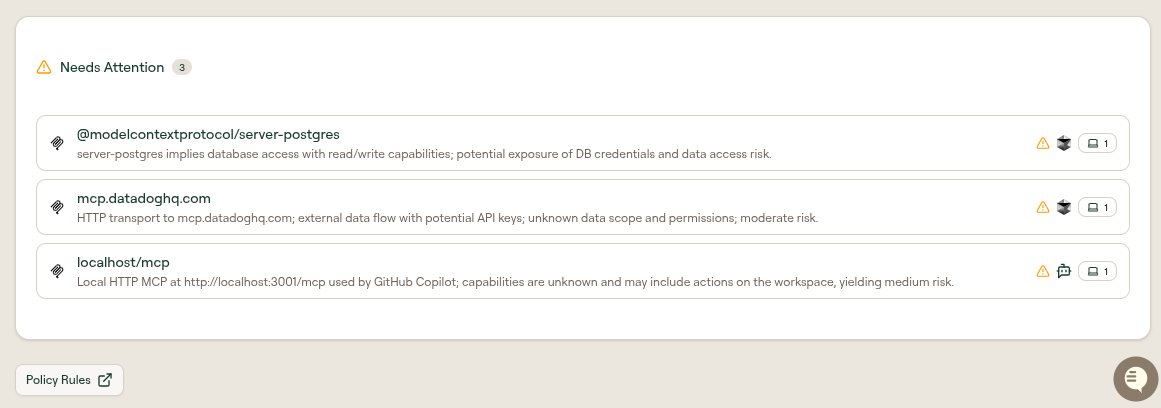
Further down, a Needs Attention panel lists the capabilities Willow considers riskiest, each with a written explanation of why, and links through to Policy Rules.
MCP Servers and Skills
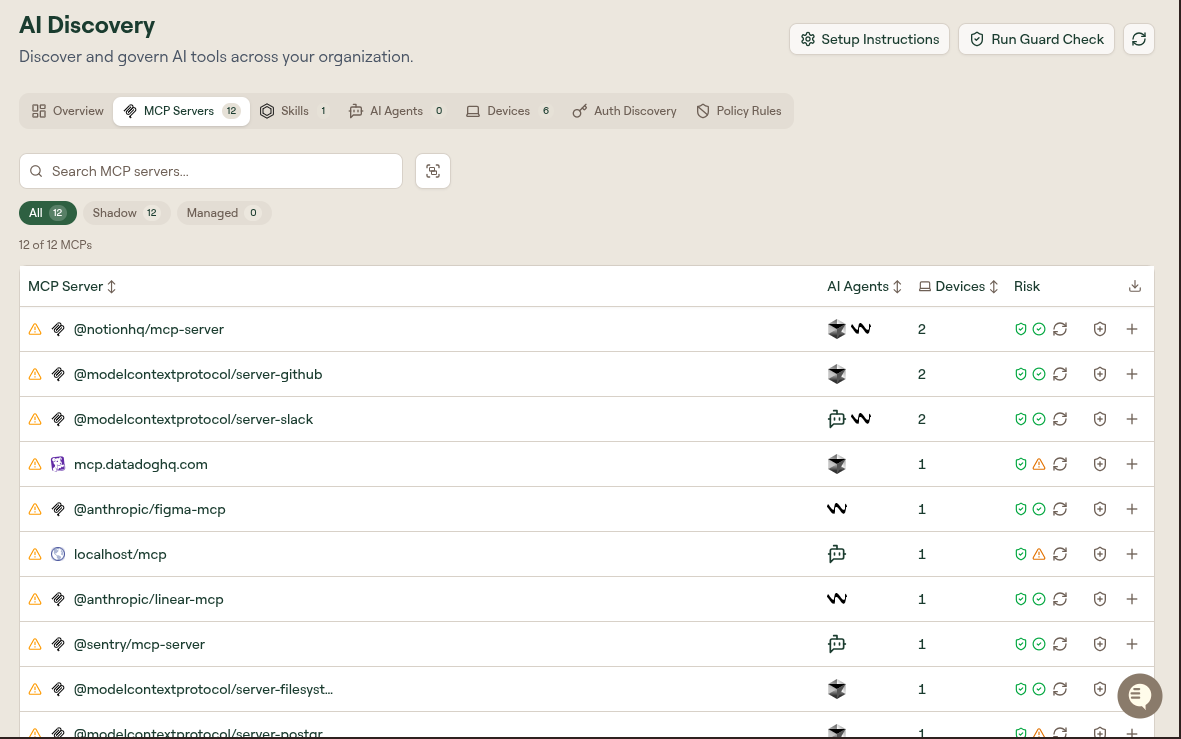
Both tabs work the same way. Search, then filter by All, Shadow, or Managed. A grouping control next to the search box groups rows by No grouping, AI Agent, or Risk. The table lists each capability with the AI agents and devices using it, and its risk status. A download icon exports the list.
Shadow capabilities are the point of the page: MCP servers and skills running on developer machines that never route through your gateway.
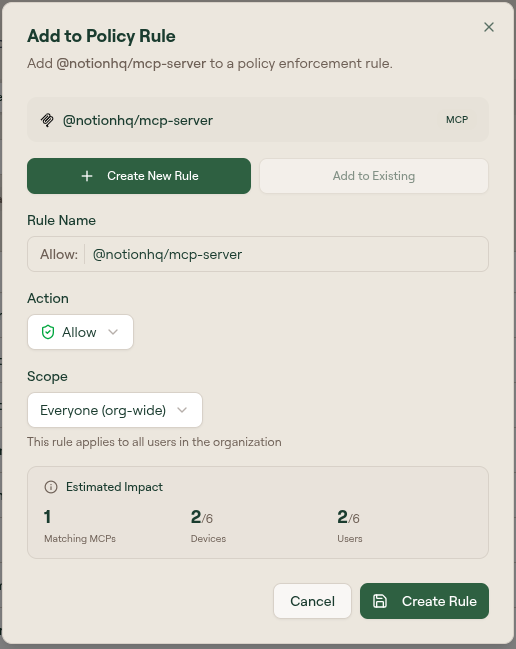
Each row carries a shield icon (its tooltip reads Add to Policy Rule) that opens the rule dialog pre-filled with that capability. You can Create New Rule or Add to Existing, and an Estimated Impact panel shows how many devices and users the rule would reach before you commit. The + icon at the end of the row is a different action: it opens Create Custom MCP to turn the discovered server into a managed integration.
Selecting a capability (from either table or from the Needs Attention panel) opens a detail drawer with its transport and command, the file locations and devices it was found on, the AI agents using it, its Guard Check result, and its AI Risk Assessment: a band and a 0–10 score, for example Medium Risk, 6/10, with the reasoning behind it and the date it was assessed. See How Willow assesses risk for the shared risk model.
Agent Memory
An agent's memory file is the standing instruction it reads before every run. CLAUDE.md and AGENTS.md sit in a repository or a home directory, are edited by whoever works on the machine, and never pass through the gateway — so their contents shape agent behavior without appearing anywhere in your tool-call logs.
The Agent Memory tab is the inventory of those files across your fleet. It is populated by the scan agent, so until devices report it reads No agent memory files discovered yet. CLAUDE.md and AGENTS.md files will appear here once devices report scan data.
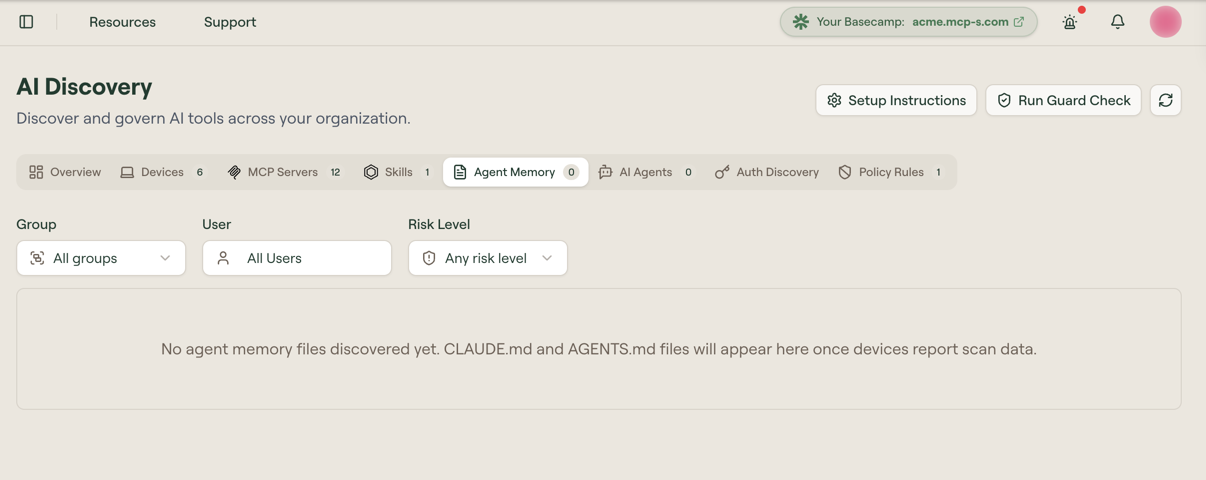
Three filters narrow the list:
| Filter | Narrows to |
|---|---|
| Group | Files on the devices of users in a group. Defaults to All groups. |
| User | Files belonging to one user. Defaults to All Users. |
| Risk Level | Files at a given risk level. Defaults to Any risk level. |
Filter by risk level first. A memory file that instructs an agent to skip confirmation prompts, or that carries a credential inline, is the kind of thing this tab exists to surface.
AI Agents
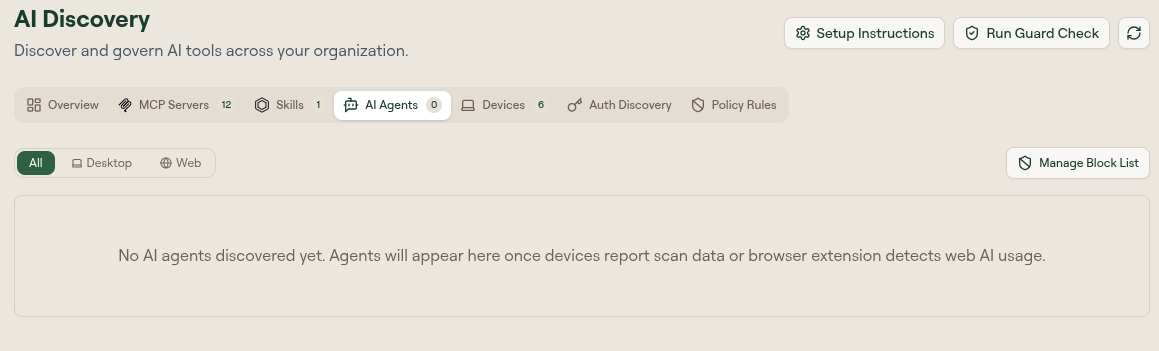
Filter by All, Desktop, or Web. The tab stays empty until devices report scan data or the browser extension detects web AI usage.
Manage Block List opens Web AI Agents - Block List, where you set a policy for web AI agents that have not been detected in your organization yet, including ChatGPT, Claude, Gemini, Microsoft Copilot, Perplexity, DeepSeek, Mistral Le Chat, and Grok.
Devices
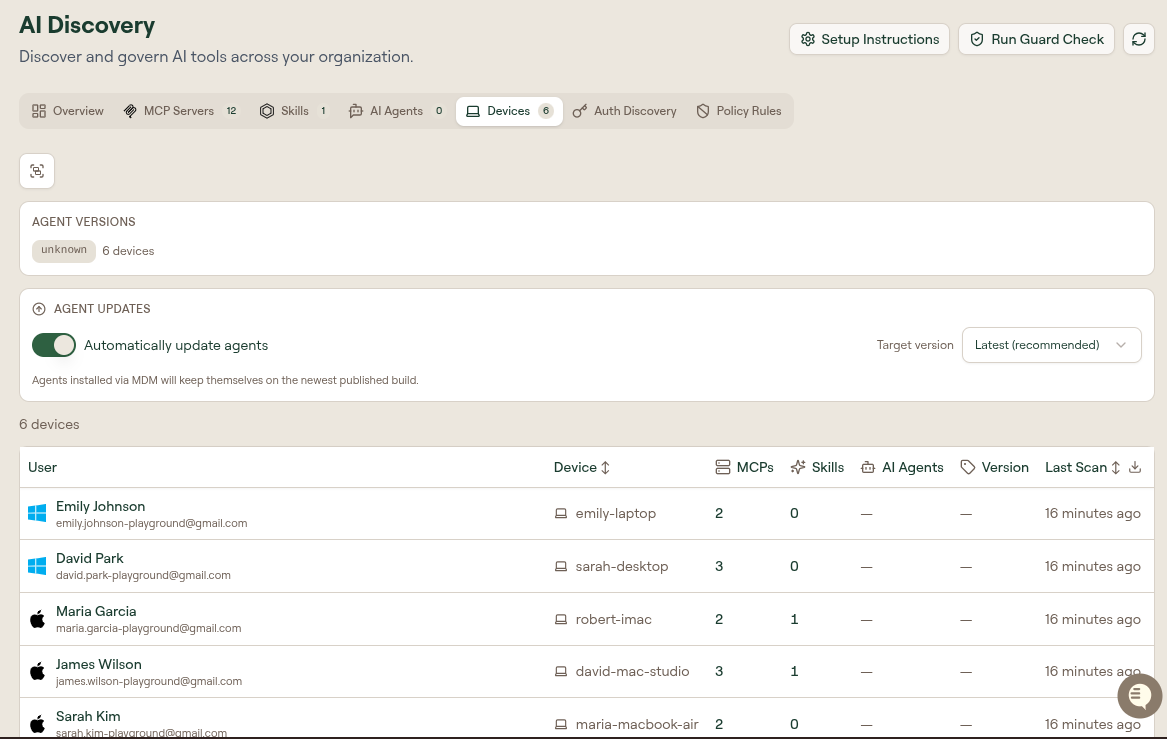
An Agent Versions card summarizes which scan agent builds are deployed. An Agent Updates card carries an Automatically update agents toggle and a Target version selector, defaulting to Latest (recommended). Agents installed via MDM keep themselves on the newest published build.
The table lists each device with its user, counts of MCPs, skills, and AI agents, its agent version, and when it last scanned. Select a device's user to reassign it.
Auth Discovery
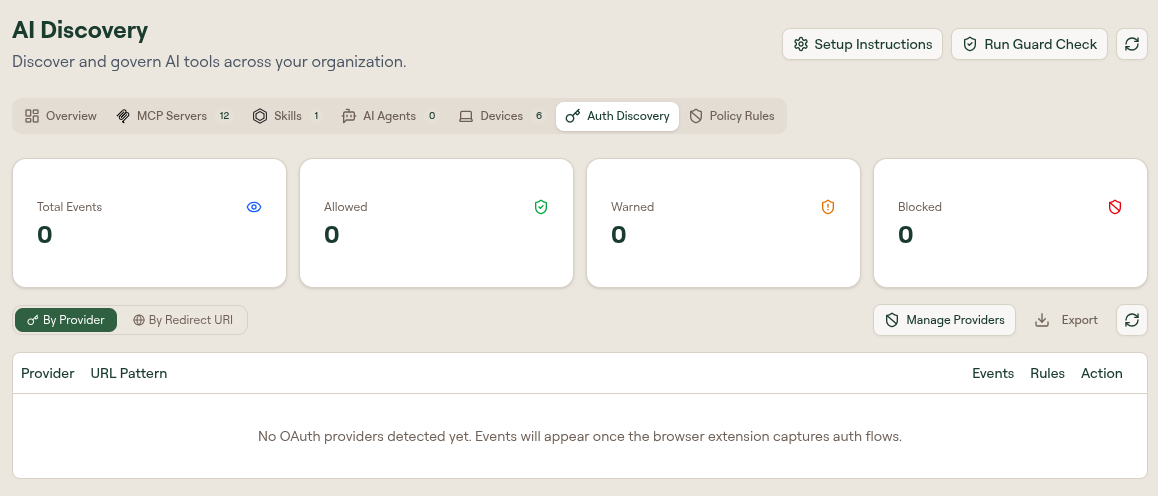
Cards count Total Events, Allowed, Warned, and Blocked. Group the table By Provider or By Redirect URI, and export it.
Manage Providers opens All OAuth Providers, where you set a policy for every known OAuth provider, including the ones not yet detected in your organization (Google, Atlassian, Microsoft, GitHub, Asana, Bitbucket, and others).
Until the browser extension captures an auth flow, the table reads No OAuth providers detected yet.
Guard Check
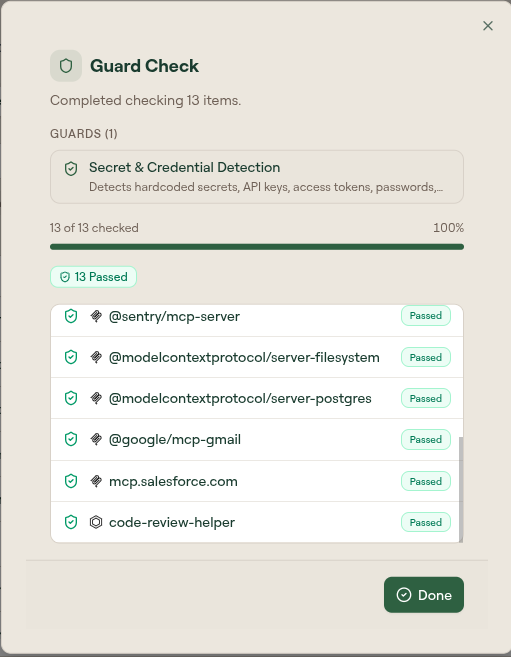
Run Guard Check evaluates every discovered capability against your enabled build-time guards. The dialog names the guards it is running, reports progress as it works through the capabilities, and marks each one Passed or flagged. Select Cancel to stop it, or Done once it completes.
Only enabled guards run. Because every guard ships disabled, a fresh organization has none to run until you turn one on. See Runtime vs build-time guards.